Formula 1 logistics: how tons of equipment make it to Brazil
Moving by air, sea, road and rail, Formula 1 runs an international operation that demands careful planning, customs coordination and precise timing.
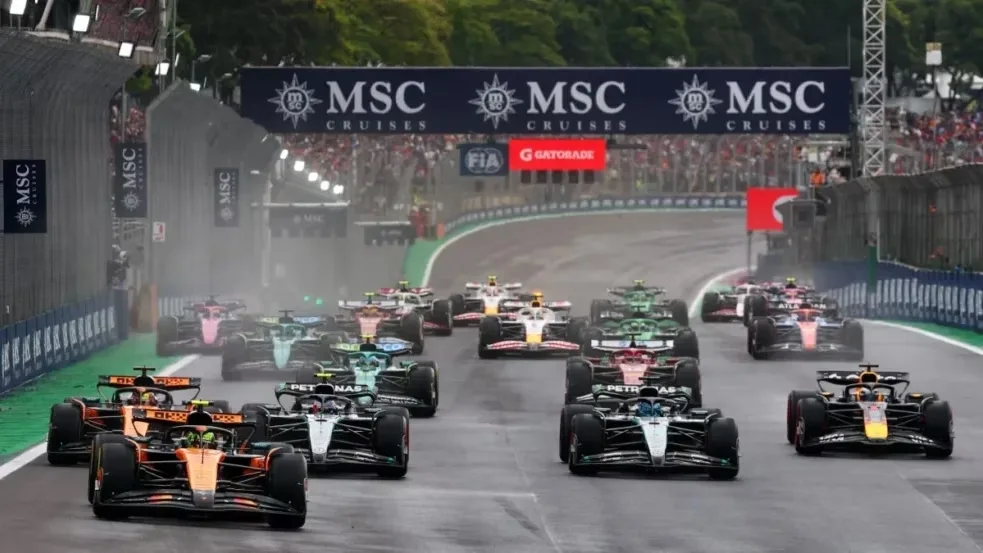
From November 6 to 8, 2026, the Interlagos circuit in São Paulo hosts another round of the Formula 1 World Championship.
For the cars to make it onto the track, an extensive logistics operation has to happen long before the start. Engines, parts, tires, tools, garage structures and broadcast equipment cross borders throughout the season.
The challenge is to move high-value cargo, meet customs requirements and keep up with an international calendar of races spread across five continents.
Up to 1,200 tons per race
According to DHL, Formula 1’s official logistics partner, each round can involve moving up to 1,200 tons of equipment.
In the 2025 season, the operation covered roughly 133,000 kilometers in flights between races, on top of the sea and land legs.
Planning starts about a year before the championship and takes into account each circuit’s characteristics, distances, transport capacity and the gaps between races. To meet this calendar, different modes of transport are used side by side.
How does Formula 1’s international transport work?
Air — speed for essential equipment. Cars, engines, critical components and broadcast equipment travel mainly on cargo aircraft. These are items that must follow the teams from one race to the next.
Sea — capacity for large volumes. Garage structures, furniture and hospitality materials travel in shipping containers, often sent weeks or months in advance. The operation uses five or six similar sets of equipment, strategically distributed around the world.
Road — linking ports, airports and circuits. Trucks handle the overland transport of cargo. For the European rounds, DHL can deploy up to 400 vehicles, including operations with two drivers per truck to meet deadlines.
Rail — an alternative added in 2026. In May, DHL completed an operation between Miami and Montreal, moving 50 containers nearly 2,000 kilometers. About 68% of the cargo handled by the company on that leg, which would normally go by road, was shifted to rail.
International routes don’t necessarily follow the calendar
One of the most interesting aspects of the operation is that not all equipment travels the same route.
In examples shared by DHL, containers sent to China may later head to Miami, while other sets circulate between Japan, Singapore and Azerbaijan.
In the 2025 season, sea freight arrived on the US West Coast from Asia and continued by truck to Miami. Essential equipment, meanwhile, was flown directly from another race.
This distribution allows less urgent cargo to take longer sea routes, while indispensable components travel with the teams.
How does the equipment get to Brazil?
The 2025 São Paulo Grand Prix gives a concrete sense of the scale involved.
Viracopos International Airport, in Campinas, handled an operation scheduled to move approximately 700 tons of equipment on eight cargo flights.
The first aircraft, a Boeing 747-400F from Mexico City, landed on October 28. The operation involved about 100 airport staff and an estimated 100 truck trips to São Paulo.
By sea, around 180 containers were part of the event’s logistics, according to the trade publication Tecnologística. Hellmann Worldwide Logistics documented the shipment of 141 containers from France to Brazil, including customs coordination and delivery for assembly at Interlagos.
These figures refer to 2025 and serve as a historical reference, not as a forecast of cargo volumes for 2026.
Mexico, São Paulo and Las Vegas: the 2026 time squeeze
The calendar places the Mexico City Grand Prix from October 30 to November 1, São Paulo from November 6 to 8 and Las Vegas from November 19 to 21.
Between the end of the Mexico City Grand Prix and the start of activities at Interlagos, there are only five full days. In that window, essential equipment must be dismantled, packed, shipped and prepared for a new race.
In 2025, the logistics team reported a window of roughly seven to eight hours to pull out and pack the priority materials after the race in São Paulo.
The role of customs in moving the equipment
Bringing cargo into Brazil involves import procedures, documentation and specific controls.
Certain equipment used at international events may enter under the temporary admission regime, which allows goods into the country for a set period, subject to legal conditions and the obligation to give them a proper destination when the regime ends.
For the 2025 operation, Hellmann reported coordinating customs clearance, temporary admission procedures and bonded storage to enable the assembly of the structures.
How much does it cost to move Formula 1?
There is no consolidated public figure that pinpoints the total logistics cost of a season.
Expenses include air charter, sea freight, road haulage, storage, insurance, customs services and the handling of specialized equipment.
Formula 1 recorded approximately US$3.87 billion in revenue in 2025, according to Liberty Media’s financial statements. That figure is the sport’s revenue, not its transport spending.
The logistics challenge lies in balancing speed, cost and reliability in an activity where delays can put a race at risk.
What does this operation reveal about foreign trade and FX?
Moving goods across borders also involves contracts, insurance, services and financial commitments between companies in different countries.
International freight, storage and specialized services may be contracted in foreign currencies. When there is a gap between contracting and payment, exchange rate swings can change the final cost in reais.
That is why companies engaged in foreign trade need to coordinate logistics planning with finance.
Defining commitments early, monitoring currencies and assessing settlement or hedging alternatives can make costs more predictable.
Formula 1 is an extraordinary-scale example of this dynamic, but the same principles apply to the day-to-day operations of importers, exporters and freight forwarders.
Efficient transport, proper documentation and FX planning are all part of the same international operation.
Editorial sources
- Formula 1 — 2026 calendar: formula1.com
- DHL — Inside F1 Logistics: dhl.com
- DHL Group — Miami–Montreal rail transport (2026): group.dhl.com
- Hellmann — 141 containers shipped from France to Brazil (2025): hellmann.com
- Liberty Media — 2025 financial statements: libertymedia.com