From the Cruzeiro to the Real: why did Brazil change its currency so many times?
Brazil has had eight monetary standards since 1942. Understand the changes, how the Real Plan defeated hyperinflation and the challenges that remain.
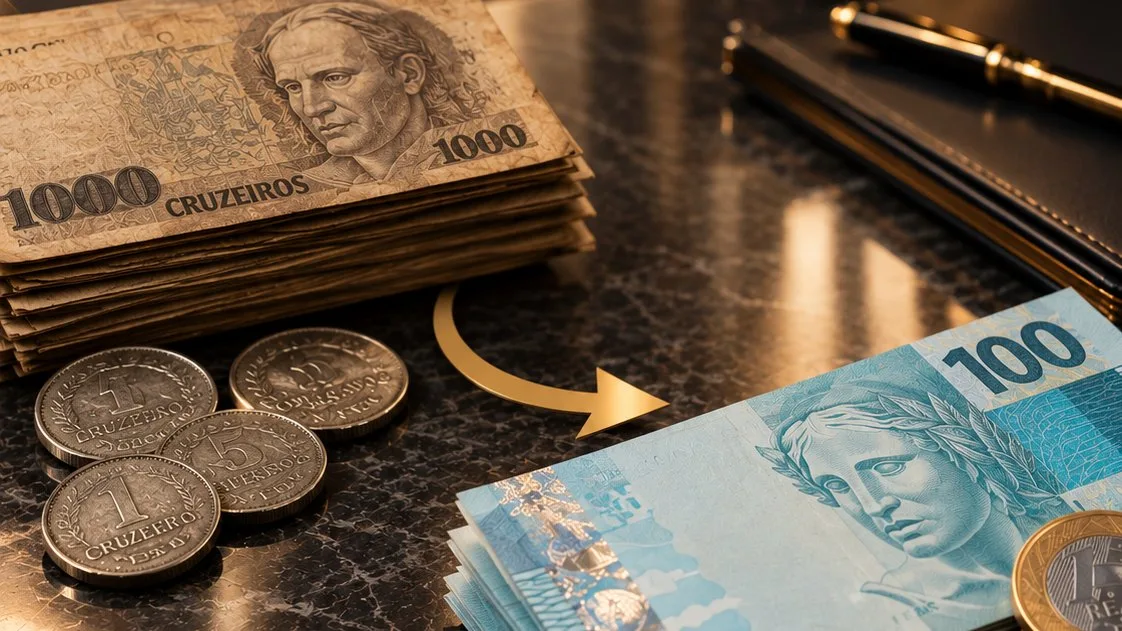
Anyone who lived in Brazil through the 1980s and 1990s probably remembers supermarket prices being relabeled, banknotes worth thousands of units and the constant changes to the name of the money. For decades, inflation rapidly eroded people’s purchasing power. But why change the currency so many times?
Eight currencies in just over 50 years
Brazil’s monetary history since 1942:
- Cruzeiro (1942–1967)
- Cruzeiro Novo (1967–1970)
- Cruzeiro (1970–1986)
- Cruzado (1986–1989)
- Cruzado Novo (1989–1990)
- Cruzeiro (1990–1993)
- Cruzeiro Real (1993–1994)
- Real (1994–present)
Source: Banco Central do Brasil • Royal Partner Câmbio.
Many reforms removed zeros to make payments easier. That simplified the figures but did not remove the causes of inflation. As long as the imbalances persisted, prices started rising again.
Why was Brazilian inflation so high?
- Fiscal imbalance: difficulties in financing the public accounts fed monetary and inflationary pressures.
- Indexation: wages, rents and contracts were adjusted for past inflation, fueling new rounds of increases.
- Loss of confidence: the expectation of price rises led companies and consumers to bring forward decisions and price hikes.
In June 1994, 12-month IPCA inflation reached approximately 4,922%. For comparison, 100% inflation already means that a R$10 product ends up costing R$20.
Why did the Real Plan work?
The Real Plan was not just about new banknotes. It included fiscal measures and the Real Unit of Value (URV), a stable reference used to adjust prices, wages and contracts before the currency changeover. The URV helped break the cycle of automatic adjustments known as inertial inflation.
On July 1, 1994, the Real entered circulation: R$1 was worth 2,750 cruzeiros reais. The new currency, combined with monetary policy, the initial exchange rate strategy and a shift in expectations, quickly brought inflation down. Since 1999, Brazil has operated an inflation-targeting regime with a floating exchange rate.
Is the Real still a stable currency?
Yes, in the sense that Brazil no longer experiences the hyperinflation seen before 1994 and has the tools to keep prices under control. That does not mean zero inflation or a fixed dollar rate. The continuous inflation target is 3% a year, with a tolerance band of 1.5 percentage points either way.
Monetary stability means keeping inflation relatively low and predictable. Exchange rate stability concerns the value of the Real against other currencies. They are different concepts.
The challenges ahead
The path of public debt, fiscal deficits and economic expectations can put pressure on interest rates, the exchange rate and inflation. Productivity gains, investment and greater economic efficiency are also essential.
The story of the eight currencies leaves one lesson: it is not changing the money that controls inflation, but the ability to preserve its value.
Royal tip
International diversification can help reduce the concentration of wealth in a single currency or market. Whether it is suitable depends on each investor’s or company’s goals, risk profile and needs. International assets also carry currency, market and liquidity risks.
Royal Partner Câmbio | The FX boutique for global companies, investors and families.
Disclaimer: informational and educational content, not an individual recommendation on investments or FX transactions.
Sources: Banco Central do Brasil (monetary standards, Real Plan and inflation targets); IBGE (historical IPCA series).