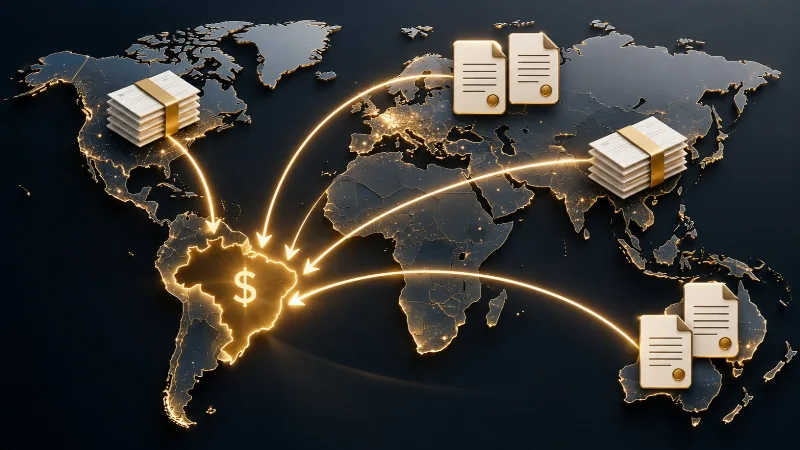
International payments with stablecoins: how the sandwich model works
Learn how the sandwich model combines an on-ramp in Brazil, the transfer of a virtual asset and an off-ramp abroad, and the regulatory, tax and documentation care it requires.

The use of stablecoins in international payments is no longer just a technology discussion. Companies are already starting to use them as part of the infrastructure for settling obligations abroad, especially when they want speed, traceability and new alternatives to traditional channels.
One of the structures gaining ground is the so-called sandwich model, which combines an on-ramp in Brazil, the transfer of the virtual asset and an off-ramp abroad.
How does it work?
In simple terms: BRL → stablecoin → USD/EUR/other currency → beneficiary.
In the on-ramp, the company uses reais to buy a stablecoin such as USDT or USDC. The asset is transferred and, in the off-ramp, converted back into fiat currency to pay the beneficiary into their bank account abroad.
Imagine, for example, a Brazilian company with a USD 50,000 international freight invoice. Instead of a conventional bank remittance, it buys stablecoins in Brazil. These assets travel along the digital rail and are converted abroad, where the provider receives the USD 50,000 in its bank account.
The commercial obligation is still the freight. The stablecoin acts as an intermediate instrument to settle it.
Is this structure legal?
Brazilian regulation has advanced significantly on this subject.
The Central Bank of Brazil now expressly regulates the provision of virtual asset services and the situations in which these assets are used in international payments and transfers.
That changes the discussion considerably. The question is no longer simply whether a stablecoin can be used. It is about understanding who takes part in the transaction, what its purpose is, how it is documented and which regulatory, tax and accounting rules must be followed.
We are therefore in a period of regulatory transition and consolidation, which calls for special attention to the structure used in each transaction.
What about IOF?
This is one of the main attractions discussed in this market, but it calls for caution.
In certain structures, the step carried out in Brazil consists of acquiring a virtual asset rather than a conventional FX settlement. This feature has underpinned arguments that IOF-Câmbio, Brazil’s tax on foreign exchange transactions, does not apply.
On the other hand, the regulatory environment has changed, and the Central Bank now classifies certain international transactions involving virtual assets as part of the FX market.
For this reason, we do not recommend treating these transactions across the board as automatically exempt from IOF.
The classification must take into account the structure used, the nature of the obligation, the participants and the legislation in force.
Before using this model, we recommend that each company validate the transaction with its legal, tax and accounting departments or advisors.
Documentation is still essential
Changing the payment rail doesn’t change the need to substantiate the transaction.
In a freight payment, for example, there must be documents that prove the obligation and link the Brazilian payer to the contracted service and to the beneficiary abroad.
Depending on the transaction, this set may include the invoice, contract, bill of lading and other commercial documents.
We also consider it important to keep the records of both financial steps: the on-ramp, with the purchase and transfer of the stablecoin; and the off-ramp, with the conversion of the asset and the actual payment to the beneficiary.
Ideally, the company should be able to show a simple documentary trail: source of funds → asset purchase → transfer → conversion → payment of the obligation.
What about the accounting?
If the stablecoin was acquired specifically to pay an international obligation, our preliminary view is that the accounting team should receive enough documentation to analyze and record both the acquisition of the virtual asset and its use or derecognition to settle the obligation with the supplier.
Any costs, fees and value differences arising during the process should also be assessed.
There is, however, no single guideline that applies to every company or transaction. The accounting and tax treatment must be defined by the client’s own accountant and advisors.
Why has freight embraced this model?
International freight and logistics have features that fit this kind of infrastructure well: recurring payments, multiple beneficiaries, several jurisdictions and the need for efficient settlement.
But its use is not limited to the sector.
We have also seen interest in payments related to travel and hospitality, technology and software, advertising, consulting, professional services, events, education and other services contracted abroad, always respecting the classification of each transaction.
eFX transactions have their own rules and characteristics and are not part of the structure covered in this article.
What is Royal Partner’s role?
Royal Partner acts as the orchestrator of these payment routes.
Our job is to connect the client’s needs to the different participants in the infrastructure, including PSAVs (Brazil’s licensed virtual asset service providers), financial institutions and international partners, weighing factors such as currency, country, beneficiary, documentation, timing and cost.
In the structures Royal makes available, we seek to work with an off-ramp carried out by a regulated institution or a participant subject to the applicable supervision in its jurisdiction, so that the beneficiary receives the funds in fiat currency in their bank account.
We do not replace the client’s legal or accounting teams. Our role lies in structuring and operationally coordinating the payment, with attention to documentation and to the participants involved.
A new rail for international payments
Stablecoins are starting to play a different role from the one they first became known for.
Instead of being used only as investment or trading assets, they are also becoming settlement infrastructure.
For companies that make recurring international payments, this can be an interesting alternative to traditional models.
But technology does not remove the fundamentals of a sound international transaction: a legitimate source of funds, a proven economic obligation, identification of the parties, documentation, traceability and proper legal, tax and accounting treatment.
It is precisely in this combination of new payment methods and governance that this market is expected to mature.
This content is for information purposes only and does not constitute legal, accounting or tax advice. Whether the structures described apply, including whether IOF and other taxes are levied, must be analyzed individually by each client with their legal, tax and accounting advisors, taking into account the nature of the transaction, the participants involved and the regulations in force.